Airborne FTG for Geothermal exploration

Bell Geospace helps answer three important questions for Geothermal Exploration projects

  1. Where are the large-scale structural controls?


  2. Where are density contrasts linked to faulting or basin geometry?

  3. Where should seismic be focused?


Gravity Gradiomery data is particularly useful in geothermal exploration because many geothermal systems are controlled by deep structural features, such as faults, basin margins, and basement highs. Airborne gravity allows us to map these structures quickly and consistently across large areas, even where seismic or well data are limited.

Bell Geospace FTG helps identify basin geometry, major fault corridors, the depth to basement, and density variations associated with potential reservoir systems.


Five Reasons Bell Geospace FTG is suitable for Geothermal Exploration projects

  1. Unmatched Precision: FTG provides unmatched precision in mapping the subsurface density variations, aiding in identifying potential geothermal reservoirs and geological structures. With our high-resolution data, you can confidently make informed decisions on drilling targets and resource assessment.


  2. Comprehensive Subsurface Imaging: By capturing the full tensor of gravity gradients, FTG offers comprehensive imaging of subsurface structures, including fault systems, fractures, and fluid pathways. This detailed insight helps you understand the complex geology crucial to geothermal energy prospecting.


  3. Reduced Exploration Risk: Traditional exploration methods can be time-consuming and costly. Bell Geospace FTG accelerates the exploration process by rapidly surveying areas whilst offering complete coverage thus reducing exploration risk, and increasing the likelihood of successful geothermal discoveries.


  4. Environmental Responsibility and Community Sensitivity: FTG is a non-invasive and quiet exploration technique that minimises disturbance to the surrounding ecosystems and communities, aligning with sustainable geothermal development practices.


  5. Customised Solutions: Every geothermal exploration project is unique. Our technology and our survey plans are adaptable and can be tailored to a project's specific requirements, whether you're conducting regional surveys or detailed local investigations

Geothermal Client Testimonials 

Slide 1 (2)

Our experience with Bell Geospace has been very positive from the initial contact through the execution and the subsequent work. Bell independently handled all milestones and tasks. We used the data for our geothermal exploration and thus for optimising the subsurface model.  We couldn't have covered such a large area in such a short time with any other preliminary survey. This allows us to apply our seismic surveys in a much more targeted way. Thank you Bell!


Slide 1 copy 1 (1)

We conducted the survery because we believe that state of the art FTG should be part of each geothermal and lithium exploration workflow before 2D or 3D seismic data is acquired.  Working with Bell Geospace was very constructive, result-orientated and professional.  We enjoyed it greatly! We plan to use the result for regional asset assessement, design of next exploration measures as 3D seismic and to enhance our multi-physics based reservoir characterisation. 
 

geothermal case thumb

Crescent Valley Case Study

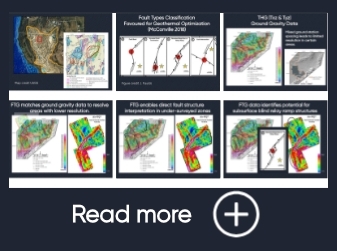
FTG data reveals previously unmapped faults and identifies their relationship to the regional structural framework. Intersections of faults are identified through lineament extraction methodologies, which in turn contribute to the identification of favourable geothermal prospects.

data-aquisition

How Data is Acquired

Bell Geospace operates three Basler BT-67 aircraft equipped with full tensor gravity gradiometry technology, scalar gravity, and magnetics. They are designed perfectly for long range and low flights and are especially adapted for low noise and low impact.

podcast copy 1

Geothermal Podcast 

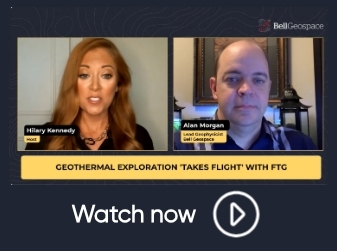
Alan Morgan, Senior Geoscientist at Bell Geospace discusses the role of identifying faults when evaluating geothermal resources. He explains how  FTG can be used to quantify subtle changes in density contrast associated with faulting and find density contrasts in the near-surface.